Nov 04, 2026
A shop quoting twenty stainless shells a month, 6 mm plate by 1500 mm wide, rolled to Ø600 mm, does not need a four-roll machine. A 3 roll plate rolling machine will handle that work comfortably, provided it is specified on roll diameter and pre-bending method rather than on tonnage alone.
That is the short answer, and it is worth stating plainly because most buyers start from the wrong question. They compare tonnage and price, then discover after installation that every shell has to have its ends trimmed, that roundness drifts across wide plate, or that a closed cylinder cannot be lifted off the machine at all.
The three-roll pyramid has been the standard configuration for plate rolling for decades: three contact points, two driven bottom rolls, one top roll, a wide diameter range from a single set of rolls, and a mechanical structure that is inexpensive to keep running. Where the design splits is in how the rolls move, and that is what decides your cycle time.
Content
In a three-roll machine the two bottom rolls are driven by the main motor and turn in the same direction, while the top roll descends between them. The plate is gripped along three contact lines, and the depth to which the top roll is lowered is what pushes the material past yield. Nothing is fixed by a die, so one set of rolls covers a wide range of diameters, commonly anything from about 1.3 times the top roll diameter upward.
Because the sheet has to be fed back and forth, the ends never pass under the top roll on the early passes. That straight, unbent section is the most important practical difference between machine types, and it is the reason pre-bending exists.
Both types carry three rolls. The difference is the freedom of movement, and it changes what the operator can actually do with the machine.
On a symmetrical mechanical machine, only the top roll moves, straight down; the bottom rolls sit fixed in their bearings. The frame is simple and stiff, and this is the cheapest route to large-diameter shells. The trade-off is that the ends cannot be pre-bent, so a straight section stays flat until it is trimmed off or rolled in a separate operation.
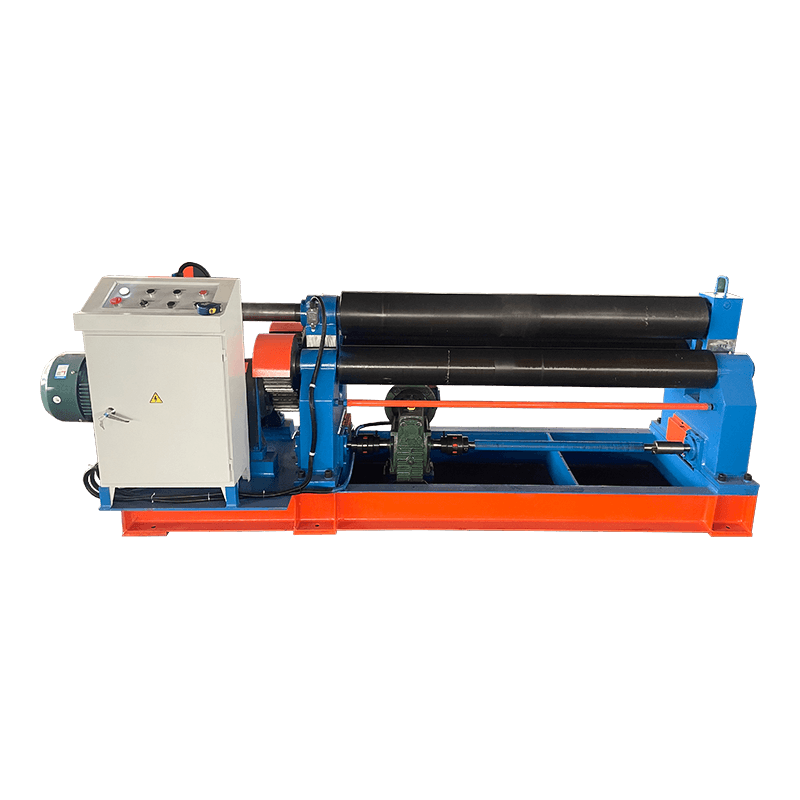 W11 Series 3-Roll Symmetrical Mechanical Plate Rolling MachineA cost-effective mechanical roller for cylindrical shells and basic curved parts, with fixed bottom rolls and no end pre-bending.View Product →
On a universal hydraulic machine, both bottom rolls move: vertically for the bend, horizontally to shift the tangent point under the top roll. That horizontal travel is what makes true pre-bending of both ends possible. Most builds also carry a hydraulic drop end so a closed cylinder can be lifted off, and some can tilt the top roll for cone work.
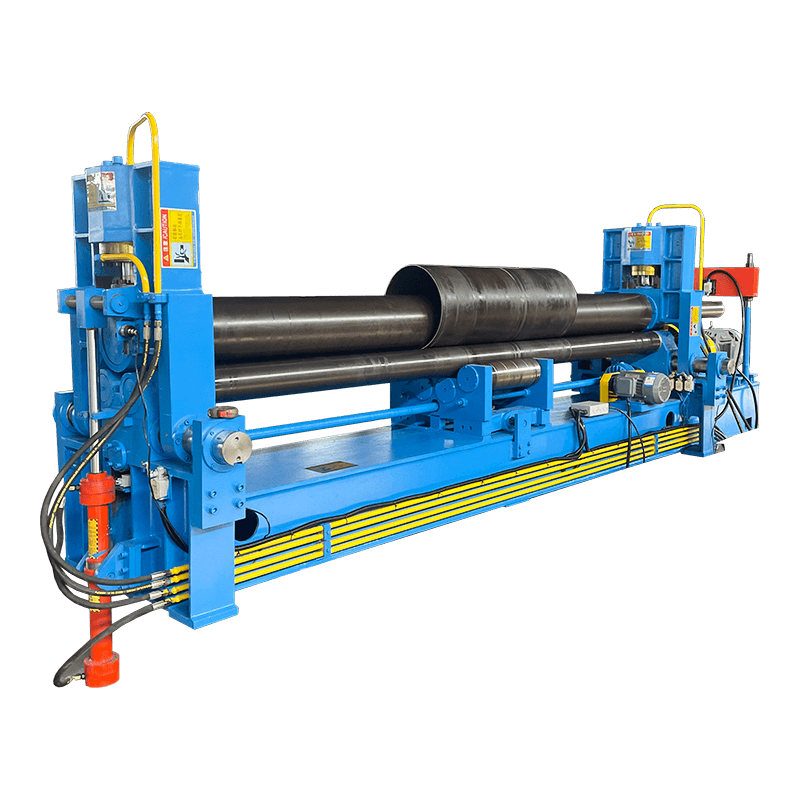 W11S Series 3-Roller Universal Hydraulic Plate Rolling MachineA hydraulic universal roller with true end pre-bending and CNC options, suited to thicker plate and stainless steel forming.View Product →
For thick plate and stainless, the second layout usually pays for itself within a year: fewer trimmed ends, fewer re-rolls, less crane time. For duct and tank work where the ends disappear into a longitudinal seam anyway, a symmetrical machine is often the more sensible purchase.
| Item | 3-roll symmetrical (mechanical) | 3-roll universal (hydraulic) |
|---|---|---|
| Roll movement | Top roll vertical only | Bottom rolls vertical and horizontal |
| Pre-bending plate ends | Not possible in one set-up | Both ends, without removing the plate |
| Flat section left at each end | Longer; usually trimmed | Short |
| Removing a closed shell | Needs overhang or a split shell | Hydraulic drop end |
| Adjustment | Manual screws, mechanical | Hydraulic, pendant control |
| Typical fit | Ducts, tanks, general fabrication | Pressure vessels, stainless, thick plate |
Catalogue capacity is almost always quoted for mild steel at full working width. Before comparing two offers, put these five items side by side:
The full plate rolling machine range is a faster way to compare roll diameters and drive types than working through individual PDF data sheets.
A quick sanity check on that chart: if your smallest shell is Ø600 mm, a 400 mm top roll puts the floor at about Ø520 mm, so the job still fits. A 500 mm roll would not.
Every three-roll machine leaves a straight section at both ends; the real question is how long it is and what you do about it. On a symmetrical machine the practical answers are trimming the end square, welding it into the longitudinal seam and planishing, or accepting a slightly oval shell and correcting it in fit-up.
Universal machines handle it with pre-bending: the operator positions the plate so the end sits directly above the tangent line between the top roll and a bottom roll, bends that short span, then rolls the full length. A four-roll machine reaches the same result with a fixed bottom roll and a side roll, and it does not need the plate turned end for end.
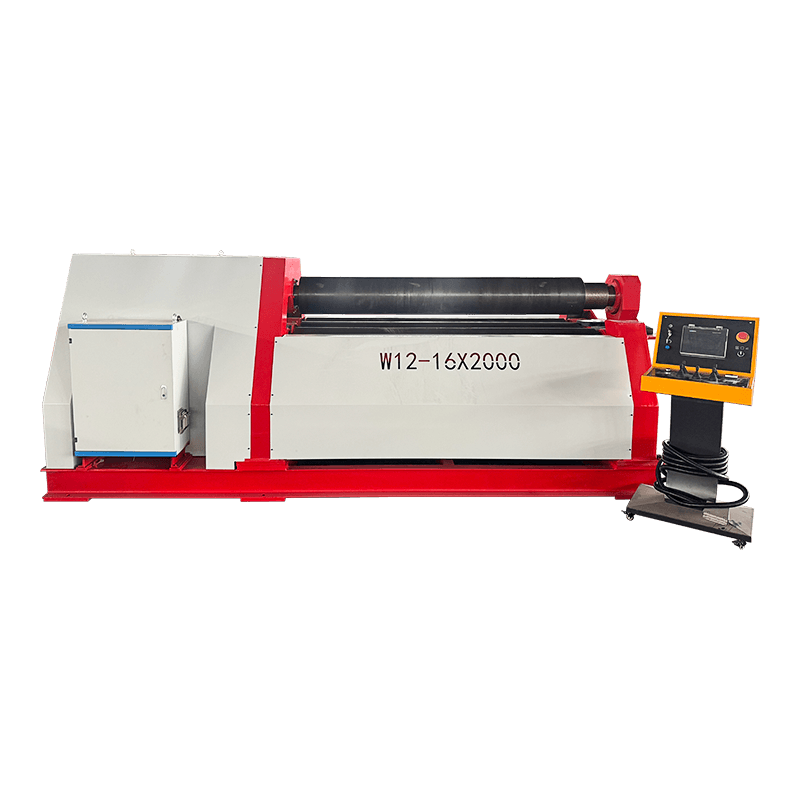 W12 Series 4-Roller Hydraulic Plate Bending and Rolling MachineA four-roller hydraulic machine that pre-bends both ends in one setup, with optional CNC roller positioning for curved work.View Product →
Springback is the other correction the operator has to make. Every material unloads differently: 304 stainless springs back noticeably more than mild steel, aluminium behaves differently again, and the allowance is found by measuring a released shell rather than a loaded one. Small increments, measured after release, beat one large guess every time.
Most complaints about three-roll machines trace back to set-up rather than to the machine itself. The checks below cover the majority of them:
The step-by-step operating guide for three-roller machines sets out pass scheduling and roll gap settings in more detail. When something does go wrong, the symptoms are usually one of five:
It rolls flat plate into cylinders, cones and arcs by bending the sheet between three rolls. Typical work includes tanks, ducts, pressure vessel shells, pipe and structural round sections in mild steel, stainless and aluminium.
Small workshop models start around 2 mm and industrial three-roll machines reach 40 mm or more at shorter working widths. Rated thickness always assumes mild steel at full width, so derate roughly 25 to 30 percent for stainless.
A three-roll machine relies on roll geometry and, on universal models, moving bottom rolls to pre-bend. A four-roll machine adds a side roll, so it pre-bends both ends without turning the plate and can roll a smaller diameter on the same top roll.
On a symmetrical three-roll machine the unbent section is long enough that it normally has to be trimmed or welded into the seam. Universal and four-roll machines reduce it to a short margin, which is why they suit closed shells and visible weld lines.
Yes, at reduced thickness. Stainless work hardens and springs back more than mild steel, so plan on more passes, a slightly larger over-roll and a capacity around 70 percent of the mild-steel rating.
Start from the smallest shell diameter and the thickest plate you will ever run, then check top roll diameter, working length and motor power against them. Buying on maximum thickness alone usually leaves you short on diameter.
Related Products

Contact us
Factory Address
Xichang industrial Park, Chengdong Town, HaianCity, Nantong City, Jiangsu Province, China
Phone
+86-13906278466
products
QR CODE

 English
 русский
 عربى