Oct 07, 2026
A fabricator sends a drawing over: 3 mm 304 stainless, 2,500 mm bend length, 90 degrees, 400 pieces a week, and a diagonal tolerance of plus or minus 0.5 mm. On paper, almost any 100-tonne press brake can produce that part. On the floor, the difference between a machine that holds the tolerance across three shifts and one that drifts after 200 strokes comes down to three mechanical facts: how the two cylinders are kept in step, how precisely the ram stops at depth, and how much the beams deflect under load.
Here is the short version of how to buy one. Settle tonnage and die opening first, then the synchronization method, then the control and backgauge, and only then compare brands and price. No controller can rescue a machine that was specified with the wrong die opening or the wrong force per metre.
Content
A press brake does not bend to an angle. It pushes a punch to a depth, and the angle is the result of that depth, the die opening, the material's yield strength and springback. Every axis on a CNC bending machine exists to hold one of those variables steady.
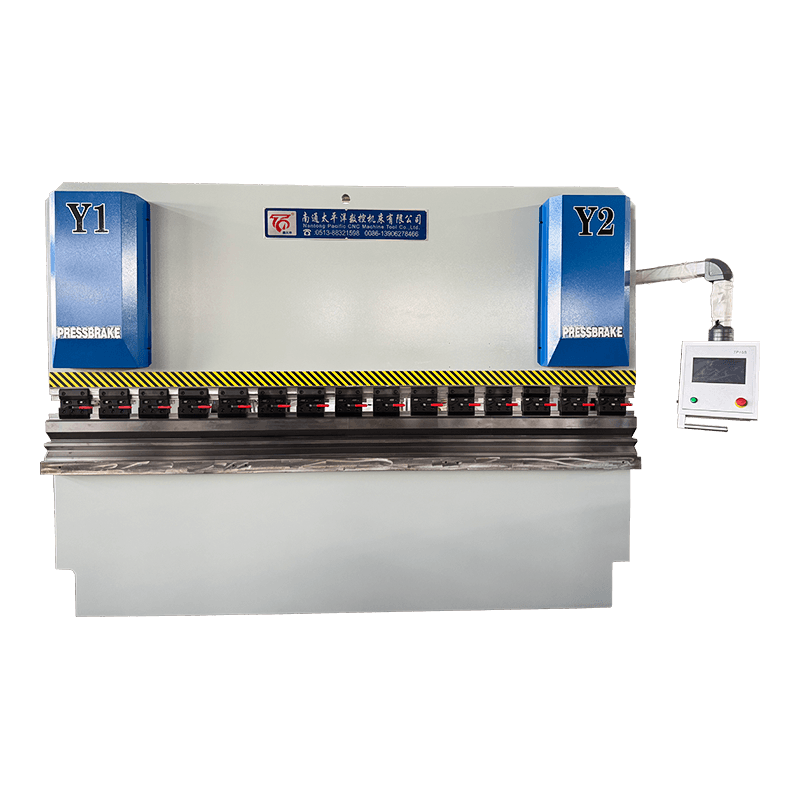
Torsion-axis machines link both cylinders through a mechanical tube, so the ram stays parallel by construction and the two sides cannot move independently. Electrohydraulic machines use a proportional valve and a linear encoder on each cylinder, and the CNC corrects Y1 and Y2 separately. The servo arrangement costs more, but it can tilt the ram deliberately, which helps with unequal flanges and with dies that have worn unevenly.
In air bending the angle is very sensitive to ram depth. Tooling guides commonly use a rule of thumb of roughly 1 degree of angle change for every 0.1 mm of depth error with a narrow V die, and less as the die opening widens. Ask for repeatability, not just resolution. A machine that positions to 0.01 mm but repeats to 0.05 mm will still scatter angles across a batch.
Under load, both beams bow in the middle, so the centre of a long part is bent to a shallower angle than the ends. Mechanical crowning wedges or hydraulic crowning cylinders lift the bed in the centre, and on programmable machines the CNC adjusts the crown as tonnage changes. If your bends are longer than about 1.5 m and your angle tolerance is tight, crowning is not optional.
The schematic below shows where those adjustments physically sit on a machine.
Annotated structure of a hydraulic press brake, showing the parts that influence bend angle.
Across our bending machine series, three press brake configurations cover most sheet metal work, and the decision is usually made by your tightest angle tolerance and your longest bend rather than by headline tonnage.
| Series | Synchronization and drive | Control | Typical fit |
|---|---|---|---|
| WE67K | Electrohydraulic servo, proportional valves with linear encoders on both cylinders | Full CNC: Y1 and Y2, backgauge X and R, crowning | Long parts, tight angle tolerance, mixed batches, stainless |
| WC67K | Torsion-axis mechanical synchronization, hydraulic drive | CNC depth and CNC backgauge | General fabrication, panels and boxes at standard tolerances |
| WC67Y | Hydraulic, torsion bar, no CNC axis | Manual or preset depth stop | Simple, repetitive bends where angle tolerance is loose |
If you bend 2 m or more at a time, run stainless or high-tensile sheet, or change between part numbers several times a shift, the independent Y1 and Y2 correction of an electrohydraulic machine usually pays back faster than the price gap suggests. It also gives you a way to work around a die that no longer sits perfectly parallel.
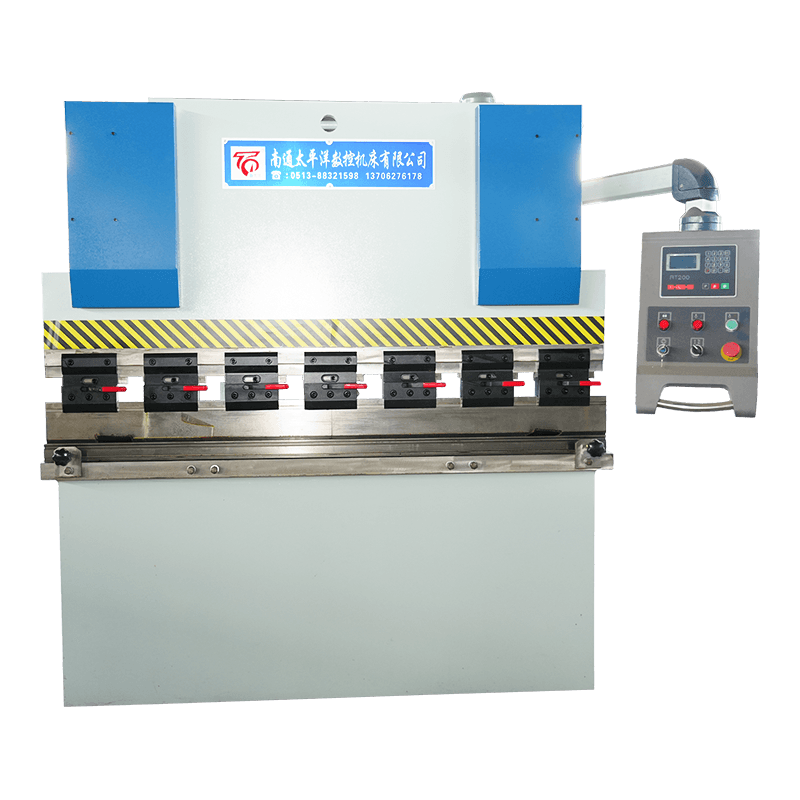
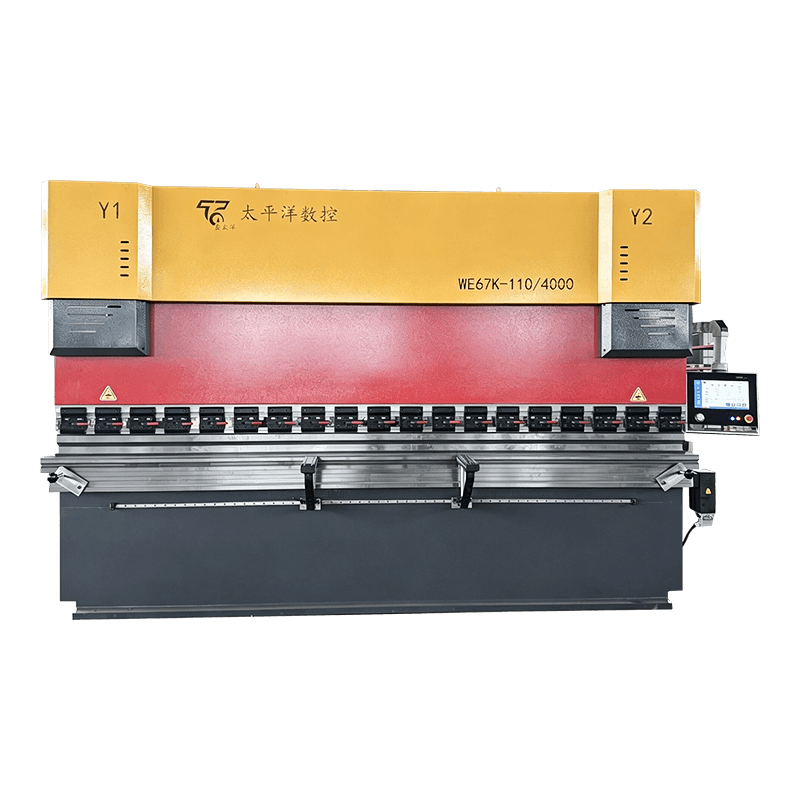 WE67K series electro-hydraulic servo CNC hydraulic sheet metal bending machineThe WE67K series electro-hydraulic servo CNC hydraulic press brake is a high-end precision bending solution developed by Nantong Pacific CNC Machine Tool Co., Ltd. It ...View Product →
Torsion-axis synchronization has fewer control loops and fewer adjustments, and on frames built from welded steel plate it delivers consistent results for years. On our WC67K series the frame structure is analysed with ANSYS stress software so the geometry is checked before the plate is cut, which matters more than catalogue numbers on long beds.
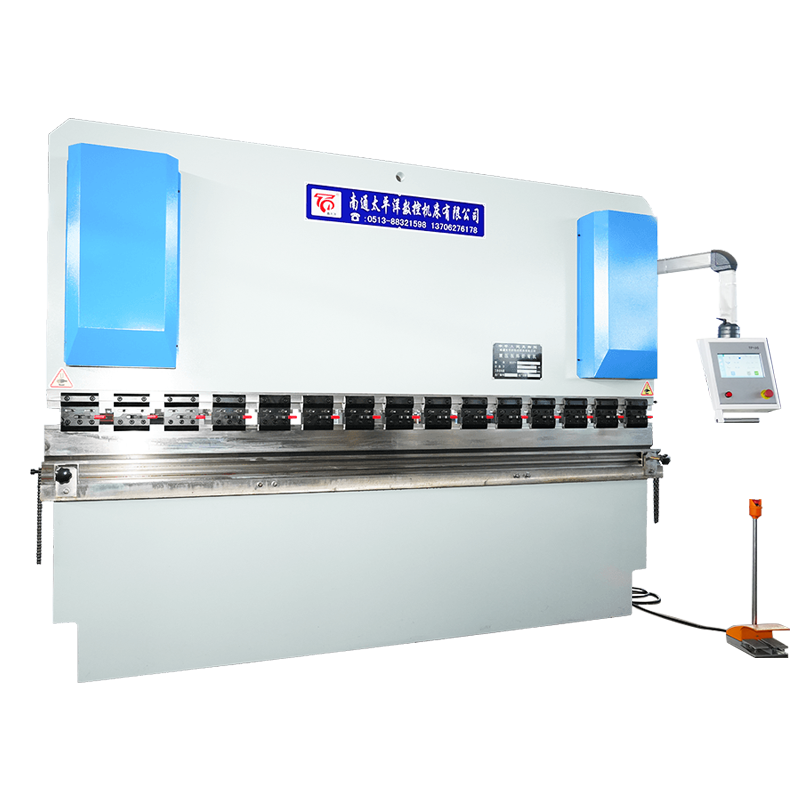 WC67K Series Torsion Axis Synchronous CNC Hydraulic Sheet Metal Bending MachineThe WC67K series torsion bar CNC hydraulic press brake is a mid-range, high-precision sheet metal bending machine, widely used in metal fabrication, electrical cabinet...View Product →
Not every job needs a CNC. For one-off brackets, simple channels and short runs where a few tenths of a degree do not matter, a plain hydraulic bending machine with a manual depth stop does the same work at a lower cost, and an experienced operator will hold tolerance by feel.
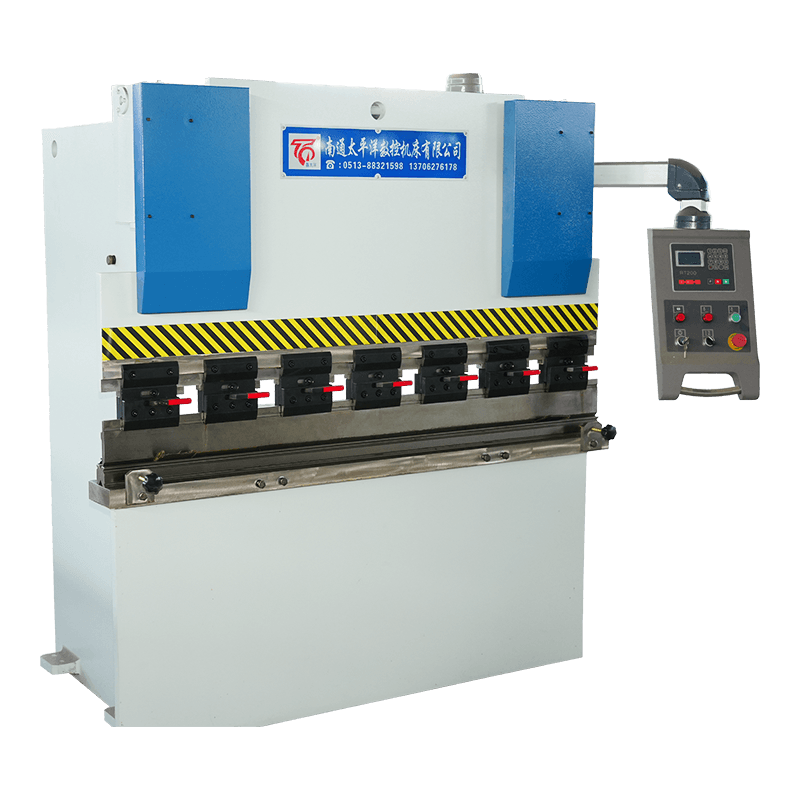 WC67Y-Series Hydraulic Sheet Metal Bending MachineThe WC67Y series hydraulic press brake is a cost-effective NC sheet metal bending machine widely used in metal fabrication workshops, HVAC production, and general manu...View Product →
A press brake rated at 100 tonnes over a 3,200 mm bed does not deliver 100 tonnes in every metre of bend. It delivers roughly 31 tonnes per metre. That single conversion explains most machines bought too small and a fair number bought far too large.
Press brake tooling charts commonly use this approximation for mild steel: required force per metre is approximately 65 x t squared divided by V, where t is sheet thickness in mm and V is the die opening in mm. Starting from the usual rule of V equals 8t, a 3 mm sheet needs about 24 tonnes per metre, and a 6 mm sheet about 47.
Required force per metre for mild steel at 90 degrees air bending, using the 65 x t squared divided by V approximation with a die opening of 8t. Multiply by the actual bend length in metres to size the machine.
Change the material and the curve moves. Stainless needs noticeably more force for the same thickness, aluminium considerably less, and both also change springback and the inside radius you will actually get.
Relative tonnage factor by material, with mild steel set at 1.00. These are approximations published in tooling charts, so confirm the real figure with your tooling supplier before ordering.
Two more numbers belong in the conversation. First, the die opening sets the shortest flange you can form: a common rule of thumb for a standard punch is about 0.7 times V, so an 8V die on 1 mm sheet leaves you needing a flange longer than roughly 5.6 mm. Second, opening the V reduces the tonnage required but increases the inside radius and the springback you have to compensate for, which is why a bigger die is not a free way out of a tonnage problem.
A press brake quotation is only comparable if both suppliers are quoting against the same duty. Send these points with the enquiry:
Most projects that disappoint go wrong on the first, third or fifth line, not on the controller brand. If you want this decision walked through with examples, our guide on how to choose the right CNC plate bending machine covers the same ground from a shop floor perspective.
Guard selection is part of the specification, not an accessory: light curtains or laser guards at the front opening, two-hand control or a guarded foot pedal, and a clear procedure for changing tooling with the ram supported. On the maintenance side, three habits protect accuracy more than any other. Keep the punch and die shoulders clean and free of burrs, because a chip under the punch shows up as an angle error on every stroke. Watch hydraulic oil temperature, since viscosity change alters how repeatably the ram stops. And check ram parallelism and backgauge play after the machine is moved or after a heavy production run, rather than waiting for parts to go out of tolerance.
It forms sheet metal into flanges, boxes, channels and panels by pressing the sheet into a V die. The CNC controls how deep the ram travels and where the backgauge stops, so the same machine can switch between part numbers without manual setting.
For mild steel, required force per metre is approximately 65 x t squared divided by V, where t is thickness in mm and V is the die opening in mm. Multiply by the bend length, then adjust for material: about 1.5 for stainless and about 0.65 for aluminium.
All of these machines are hydraulic or servo driven; CNC describes the control. A conventional hydraulic press brake uses a manual depth stop, while a CNC press brake programs ram depth on Y1 and Y2, backgauge positions on X and R, and often crowning.
Price depends mainly on tonnage, bend length, control level and tooling. A small 40-tonne machine and a 200-tonne electrohydraulic servo machine are in completely different categories, so always compare quotations that list tonnage, die opening and included tooling.
Yes. Stainless needs roughly 50 percent more force than mild steel for the same thickness and shows more springback, while aluminium needs less force but tends to mark easily, so protective film or a larger die radius is often used.
Check hydraulic oil level and temperature daily, keep punch and die shoulders clean, inspect backgauge play and belt tension weekly, and verify ram parallelism after moving the machine or a long production run. Replace filters and seals on the schedule in the manual.
One last point worth remembering when you compare offers: the specification that decides whether a machine earns its money is the tonnage per metre at your die opening, the repeatability of the ram stop, and the reach of the backgauge. Everything else is refinement. A manufacturer that can build both standard series machines and non-standard equipment is also useful to know, because part families change over the life of a press brake far more often than the machine itself does.
Related Products

Contact us
Factory Address
Xichang industrial Park, Chengdong Town, HaianCity, Nantong City, Jiangsu Province, China
Phone
+86-13906278466
products
QR CODE

 English
 русский
 عربى
عربى