Oct 21, 2026
Say you are quoting thirty shells, 3,000 mm long and 12 mm thick in mild steel. The machine that decides whether that job makes money is not the one with the biggest screen on the control panel. It is the one that can pre-bend both edges of the plate, so the finished cylinder reaches the welder round and closed instead of carrying two flat ends that somebody has to cut back and grind.
That is the short answer: choose roll geometry and forming capacity first, and buy the control system as the repeatability layer on top of them. A CNC plate rolling machine earns its keep by reproducing a result, not by creating one. What follows explains what the control can and cannot do, how the three common roll configurations differ, and which numbers are worth demanding from a builder before you sign.
Content
A plate rolling machine has very few motions. The bottom rolls travel up or down; on a four-roll machine the side roll travels in and out; the rolls rotate. There is no tool path to interpolate, which is why the control on a rolling machine sits closer to a positioning system than to the multi-axis CNC on a press brake.
In practice, CNC here means numerically controlled positioning of those linear axes, usually servo or proportional valves with position feedback, plus a screen that stores roll positions as programs. On a mechanical three-roll machine, the same adjustment is made with handwheels and a scale.
The payoff appears on repeat work. The first shell in a batch is always a trial piece, because springback changes with thickness, yield strength and even heat number. Once the roll positions are found and stored, pieces two through thirty come out to the same diameter with far less operator judgement, which matters a great deal in shops with high staff turnover.
What CNC does not do is create pre-bending geometry. If the machine cannot clamp and bend the plate edges, no controller will turn out a true cylinder. That capability comes from the frame, the roll diameters and the spacing between the rolls.
Shops comparing designs can see mechanical, hydraulic and four-roll options side by side in the plate rolling machine series.
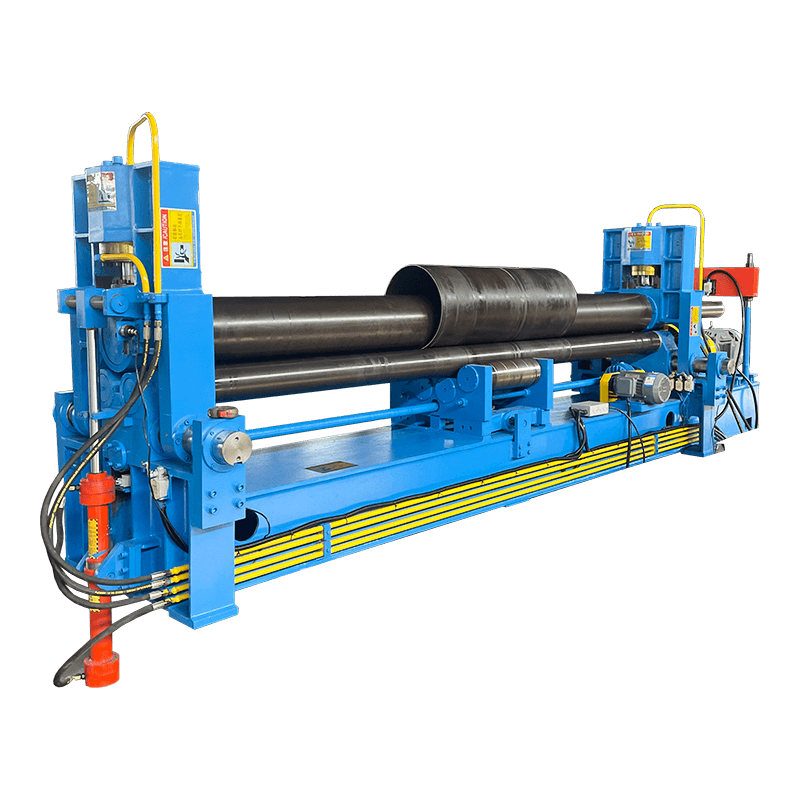 W11S Series 3-Roller Universal Hydraulic Rolling MachineReview this hydraulic three-roller option for plate rolling, with pre-bending technology, CNC control, and specifications for cylindrical, conical, and multi-radius forming.View Product →
Strip away the sales language and the three common configurations differ in one physical fact: how the plate edge is pre-bent.
A symmetrical three-roll machine has two fixed bottom rolls and a top roll that moves straight down. It is the simplest and cheapest way to roll a shell, and it is still the workhorse in plenty of job shops. The catch is at the ends. The strip sitting between the two bottom rolls never gets bent, so to pre-bend the trailing edge the operator has to take the plate out, turn it around and feed it again. On a heavy shell, that is crane time.
A universal three-roll machine adds movement to the top or bottom rolls so a pre-bent edge can pass through. Both edges are then pre-bent in one setup, and the handling time saved usually exceeds the price difference.
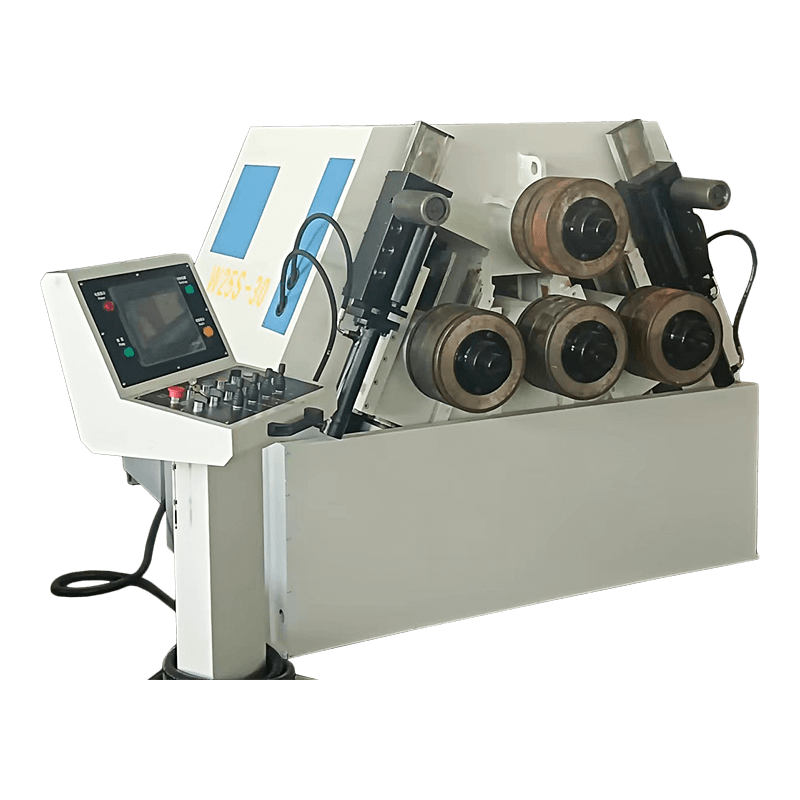
A four-roll machine uses the fourth, side roll for pre-bending. The plate stays clamped between the top and bottom rolls, both edges are bent in the same pass, and nobody turns the plate. The geometry also lets the finished shell come closer to the top roll diameter, which shortens the unbent strip left at the seam.
| Consideration | Symmetrical three-roll | Universal three-roll | Four-roll |
|---|---|---|---|
| Edge pre-bending | Needs re-feeding or a separate press | Both edges in one setup | Both edges in one pass, plate stays clamped |
| Plate handling | Highest | Medium | Lowest |
| Typical fit | Thin plate, small batches, tight budget | Mixed work, medium batches | Long shells, stainless, repeated batches |
| Relative machine price | Lowest | Medium | Highest |
| Operator skill demanded | High | Medium | Lower once programs exist |
Illustrative comparison based on machine configuration, rated on a 1 to 5 scale. It is not measured production data.
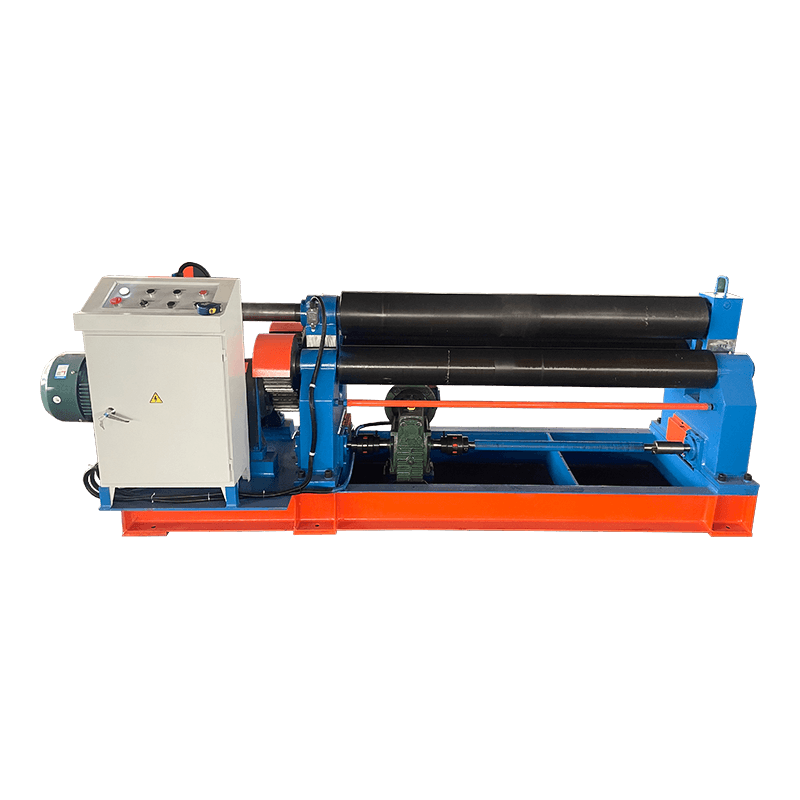 W11 Series 3-Roller Symmetrical Mechanical Plate Rolling MachineMechanical three-roller option for cylindrical and arc bending, featuring symmetrical design, RGS accuracy, MCS bearings, and tilting side rolls for conical work.View Product →
Four-roll geometry: the side roll pre-bends the edge while the top and bottom rolls keep the plate clamped.
The four rolls are only the visible part of the price. Underneath them sits a welded steel frame that must resist the separating force the rolls generate; on a machine rated for 12 mm by 3,000 mm, that force runs into hundreds of tonnes. Frame deflection does not vanish. It shows up in the finished part as a barrel shape that is fatter in the middle than at the ends, which is why builders crown the rolls or fit crowning systems on the larger models.
The other cost drivers are roll surface, hydraulics and control. Rolls are normally induction hardened against abrasion and may be chrome plated for stainless work where surface marking matters. The valves and control hardware account for a smaller share of the invoice than most buyers assume, so it rarely pays to economise there once you have already paid for a heavy frame.
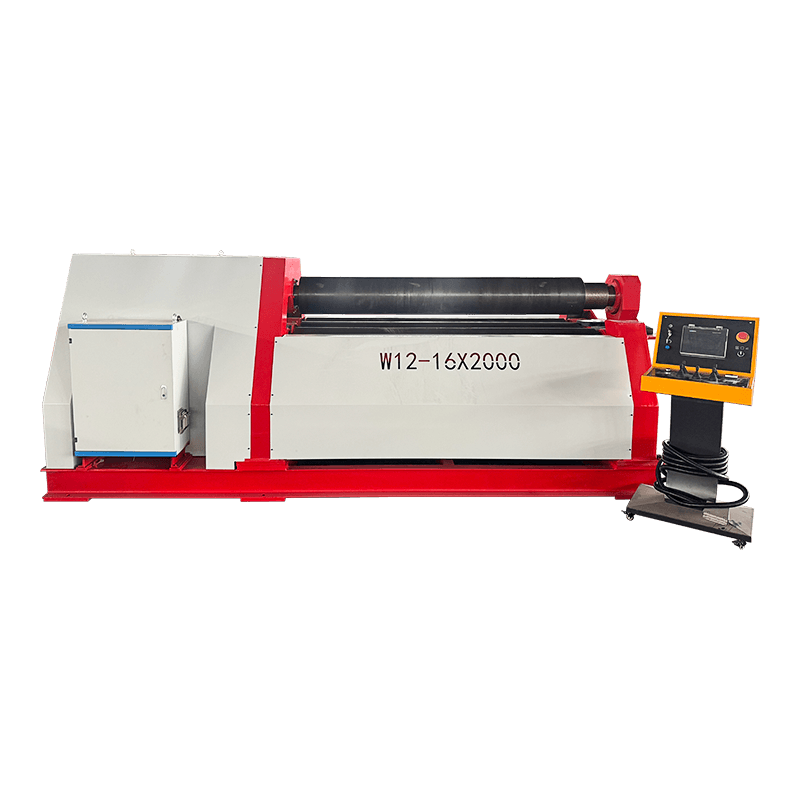 W12 Series 4-Roller Hydraulic Plate Bending and Rolling MachineHydraulic four-roller design enables one-setup pre-bending and rolling, reducing waste and improving efficiency for cylindrical, conical, and curved workpieces.View Product →
Every rolling machine ships with a capacity table. Read the line above the number you need.
The headline figure is almost always stated in mild steel, typically around 400 to 450 MPa tensile strength. Roll the same thickness in 304 stainless, or in a 700 MPa structural grade, and the machine will not reach it. Ask for a derating table for the steel you actually run instead of scaling the number yourself: rolling force rises with tensile strength, and springback and minimum diameter move with it too.
Three further numbers decide whether the machine suits your work:
One practical detail: capacity is quoted at full width. Rolling a 2,000 mm plate on a 3,000 mm machine changes the force pattern and, on some designs, the crown compensation you need for a round result.
Most unpleasant surprises in this trade are not breakdowns. They are mismatches between what the capacity chart promised and what the shop actually rolls, and a list of common plate rolling problems is a useful checklist to run against your own parts before the order goes out.
Q1. What is a CNC plate rolling machine used for?
Bending flat plate into cylinders, cones and curved shells by passing it between rotating rolls. Typical work includes tank and vessel shells, pipe and duct sections, shipbuilding panels and structural columns.
Q2. How thick a plate can a CNC plate rolling machine roll?
It depends on width and material as much as on the machine. Ratings are given in mild steel at full width; stainless and high-strength plate reduce that figure sharply, so ask for the chart that matches your grade.
Q3. What is the difference between a three-roll and a four-roll plate rolling machine?
A three-roll machine has no dedicated pre-bending roll, so the plate often has to be turned or re-fed to bend the second edge. A four-roll machine uses the side roll to pre-bend both edges while the plate stays clamped.
Q4. Can a plate rolling machine pre-bend without leaving flat ends?
Universal three-roll and four-roll machines can pre-bend both edges, but a short flat section usually remains. Its length is set by the top roll diameter and the gap between the bottom rolls, so ask for that figure first.
Q5. How much does a CNC plate rolling machine cost?
Price follows capacity, roll count, hydraulic package and control. A mechanical three-roll machine is the cheapest entry point and a fully CNC four-roll machine the most expensive. Because material derating changes the specification so much, a quotation based on your plate size and grade is the only meaningful comparison.
Q6. What maintenance does a hydraulic plate rolling machine need?
Check hydraulic oil level and condition, replace filters on schedule, keep roll surfaces clean and free of scale to prevent marking, lubricate the moving joints, and verify roll position calibration periodically so stored programs stay accurate.
Related Products

Contact us
Factory Address
Xichang industrial Park, Chengdong Town, HaianCity, Nantong City, Jiangsu Province, China
Phone
+86-13906278466
products
QR CODE

 English
 русский
 عربى