Mar 05, 2026
Content
A modern CNC steel plate rolling machine can reduce material waste by 15% to 30% and cut per-part cycle times by 40% to 55% compared to manual or older hydraulic rolling methods. These gains come from four interconnected improvements: precision digital control of roll geometry, automated material positioning, real-time springback compensation, and reduced rework rates that eliminate the most significant source of material loss in plate forming operations.
For fabricators producing cylindrical shells, pressure vessel components, pipe sections, and structural curved plates, the steel plate rolling machine is the single most productivity-critical piece of equipment on the shop floor. Getting more from it—through the right machine specification, operating practices, and process controls—delivers compounding returns across material cost, labor, throughput, and scrap rate. This article examines each efficiency lever in detail.
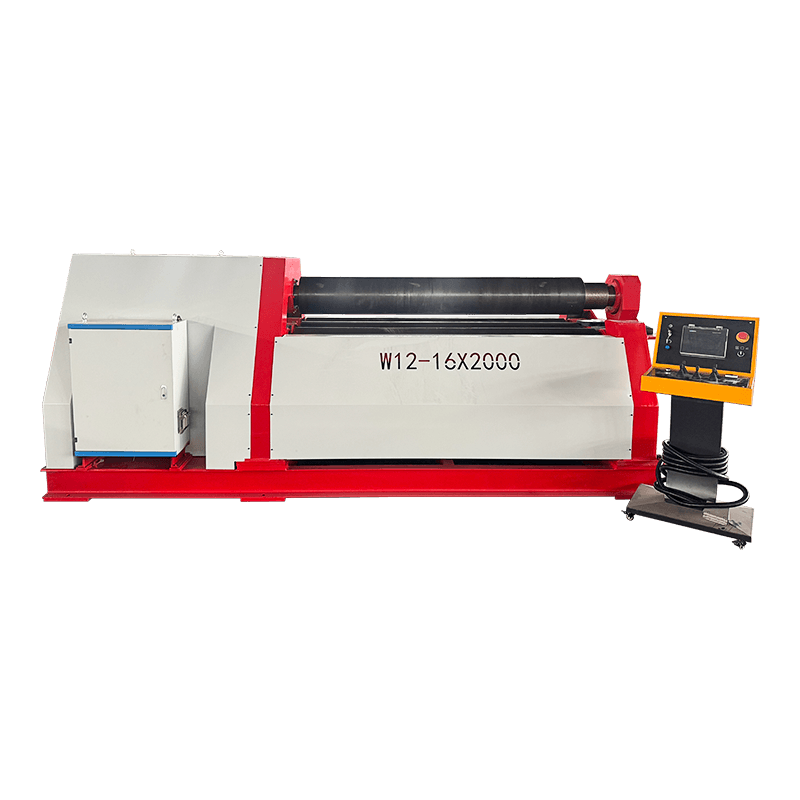
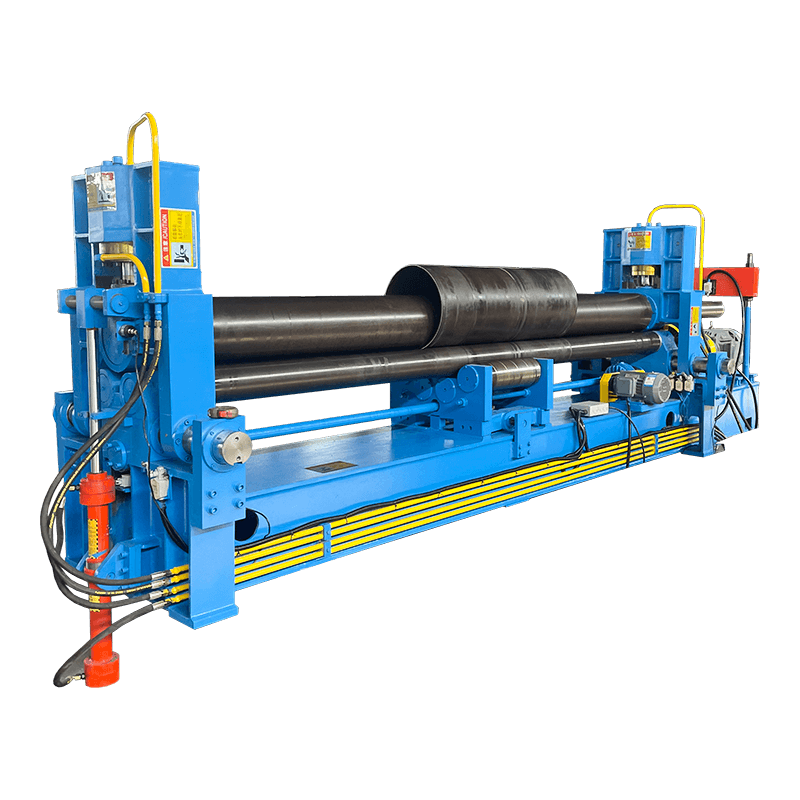
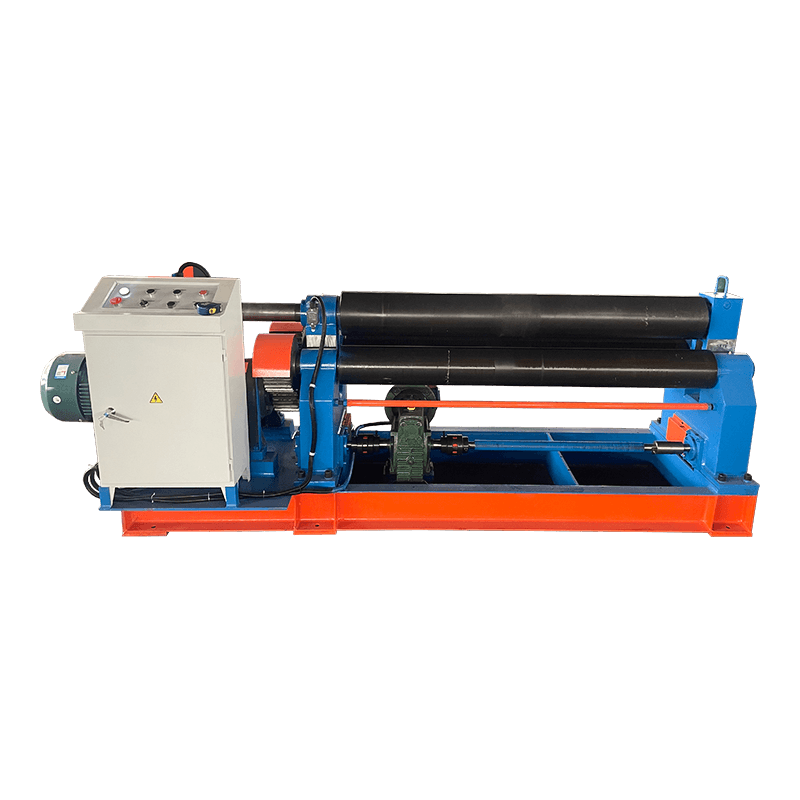
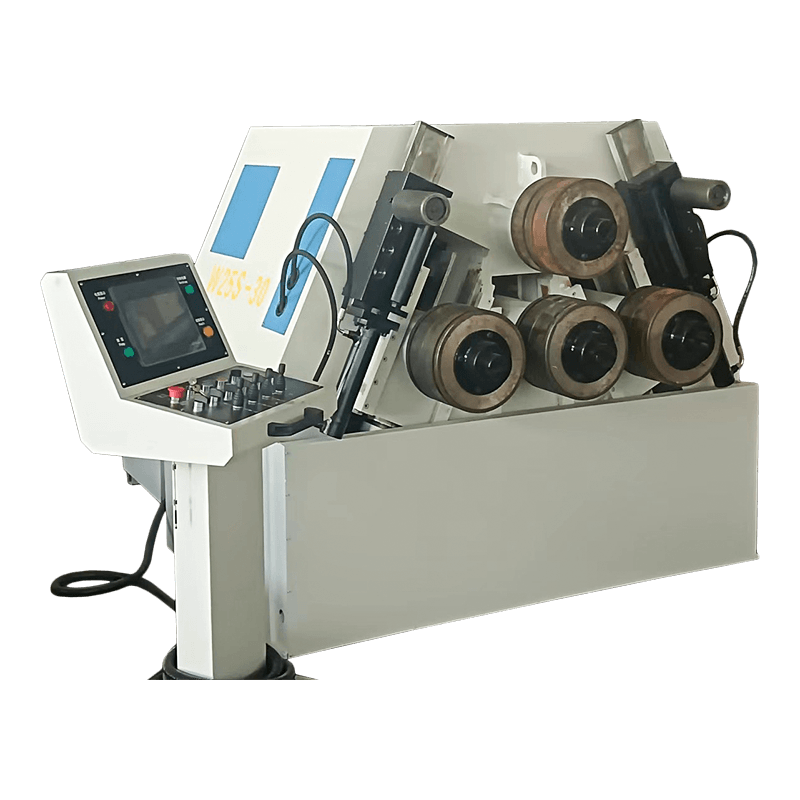
A steel plate rolling machine forms flat plate into curved or cylindrical shapes by passing the plate between a set of rolls. The geometry of the roll arrangement and the method of adjustment directly determine how accurately and efficiently parts can be produced. Understanding the four main machine types is essential before selecting or optimizing a rolling process:
| Machine Type | Roll Configuration | Flat End (Unbent Zone) | Best Application | Relative Efficiency |
|---|---|---|---|---|
| 3-Roll Symmetrical | Two bottom rolls, one top roll (fixed geometry) | Large (pre-bending required) | Large-radius, thick plate | Low–Medium |
| 3-Roll Asymmetrical | Offset bottom rolls allow edge pre-bending | Small; one-end pre-bend only | General fabrication | Medium |
| 4-Roll (Double Pinch) | Two side rolls + pinch roll + top roll | Minimal; both ends pre-bent in one setup | High-volume, precision cylinders | High |
| CNC Servo-Driven | 3- or 4-roll with digital position control | Near-zero with programmed compensation | Complex profiles, repeatable production | Very High |
The transition from a 3-roll symmetrical machine to a 4-roll CNC machine for a high-volume cylinder production line typically delivers a 40% to 60% reduction in setup time per job and eliminates the need for a separate pre-bending operation—removing an entire process step that was previously responsible for both time loss and edge-zone material rejection.
The shift from manual to CNC-controlled steel plate rolling machines represents the most significant single productivity advancement in plate forming. A skilled manual operator might achieve consistent results within ±3 to ±5 mm of target radius; a CNC machine with servo-position feedback consistently achieves ±0.5 to ±1.0 mm across the full plate length—a 5× improvement in geometric accuracy that directly reduces rework and scrap.
CNC steel plate rolling machines store roll position parameters, feed rates, and springback compensation values for each part number in a digital program library. When a repeat job is loaded, the machine configures itself to the correct parameters automatically—eliminating the 20 to 90 minutes of trial-and-error setup that manual machines require for each job changeover. In a fabrication shop producing 50 to 100 different part numbers per month, this alone can recover 30 to 50 production hours monthly.
Springback—the elastic recovery of steel after forming—is the primary cause of first-article dimensional rejection in plate rolling. It varies with material grade, plate thickness, and temperature, making it difficult to predict manually. Advanced CNC rolling machines incorporate material database-driven springback compensation algorithms that automatically adjust the roll position to over-bend the plate by the calculated springback angle, delivering the correct radius on the first pass without trial pieces. This eliminates the 1 to 3 trial plates typically consumed per job on manual machines, which in a shop processing 4 mm to 20 mm structural plate can represent $150 to $800 in material cost per job.
CNC machines can execute programmed multi-pass rolling sequences—progressively tightening the radius in calculated increments—for thick plate or tight-radius applications where single-pass rolling would exceed material yield stress and cause cracking or surface damage. This capability allows fabricators to produce parts that would be impossible or high-scrap propositions on manual equipment, expanding the productive range of the machine without additional capital investment.
Material waste in plate rolling operations comes from five specific sources. A well-specified and correctly operated steel plate rolling machine addresses each one:
On 3-roll symmetrical machines, the plate ends cannot be fully bent by the roll geometry—typically leaving 50 to 150 mm of flat unbent zone at each end that must be trimmed off or scrapped. A 4-roll machine with integrated pre-bending reduces this to under 20 mm, and CNC machines with active edge compensation can effectively eliminate measurable flat ends entirely. On a 2-meter-wide plate, eliminating 100 mm of flat end on each side recovers approximately 10% of material per part—a savings that compounds significantly at production volumes.
Manual rolling machines require operators to run trial pieces to dial in the correct roll settings for each new job. These trial pieces—typically 300 to 600 mm long—are cut from production material and discarded. CNC machines with stored programs and springback compensation eliminate this entirely. At a material cost of $2 to $5 per kg for structural steel, eliminating 2 to 3 trial pieces per job at 50 kg each represents $200 to $750 in material savings per job.
Parts rolled out of tolerance—incorrect radius, ovality in cylinders, edge waviness—must be reworked or scrapped. CNC accuracy of ±0.5 mm versus manual accuracy of ±3 to ±5 mm dramatically reduces this rejection rate. Fabricators switching from manual to CNC rolling typically report first-pass acceptance rates improving from 70–80% to 95–98%, with corresponding reductions in rework labor and material loss.
Incorrect roll pressure—common on manually adjusted machines—causes surface marking, scoring, and indentation that renders parts non-conforming for applications requiring a clean surface (pressure vessels, food-grade equipment, architectural steel). CNC machines apply precisely calculated roll pressure, and premium machines incorporate hardened, ground roll surfaces with optional polymer roll covers for stainless and aluminum plate—eliminating surface damage as a scrap source entirely.
CNC steel plate rolling machines with integrated nesting software can calculate the optimal blank length and width for each cylinder or cone section, minimizing the raw plate area consumed per part. Combined with automated plate feeders on high-volume lines, this eliminates the manual measuring and marking errors that result in over-cut or under-cut blanks—reducing overall plate consumption by 3% to 8% through nesting optimization alone.
Modern servo-electric drive systems on steel plate rolling machines deliver 20% to 35% faster roll positioning than conventional hydraulic systems, with significantly lower energy consumption—typically 40% to 60% less electrical energy per part because servo motors only draw power during active movement rather than running continuously like hydraulic power packs. For fabricators running two or three shifts, this energy reduction translates to meaningful operational savings alongside the throughput gain.
Heavy plate loading and finished part extraction are significant non-value-added time consumers on manual operations. Integrated magnetic or vacuum plate loading systems on larger steel plate rolling machines can cut plate loading time from 8 to 15 minutes (crane and manual positioning) to under 2 minutes (automated positioning with laser edge alignment). Similarly, pneumatic or hydraulic ejection systems for completed cylinders eliminate the manual extraction effort that is both time-consuming and a common source of operator injury.
High-end CNC plate rolling machines now incorporate laser or contact-probe diameter measurement systems that measure the formed radius during rolling and feed the measurement back to the CNC for immediate adjustment. This closed-loop control eliminates the stop-measure-adjust cycle on manual machines—where an operator must stop the machine, use a template or radius gauge, adjust the rolls, and restart—saving 3 to 8 minutes per measurement cycle and enabling continuous rolling to final dimension without interruption.
| Performance Metric | Manual / Older Hydraulic Machine | Modern CNC 4-Roll Machine | Improvement |
|---|---|---|---|
| Setup time per new job | 30–90 minutes | 5–15 minutes | 75–85% reduction |
| Radius accuracy | ±3 to ±5 mm | ±0.5 to ±1.0 mm | 5× improvement |
| First-pass acceptance rate | 70–80% | 95–98% | +18–28 percentage points |
| Flat-end waste per part | 100–150 mm per end | <20 mm per end | 85–90% reduction |
| Trial pieces consumed per job | 1–3 pieces | 0 | 100% elimination |
| Cycle time per part (repeat job) | Baseline (100%) | 45–60% of baseline | 40–55% faster |
| Energy consumption per part | Baseline (100%) | 40–60% of baseline | 40–60% reduction |
| Operator skill dependency | High; results vary with operator experience | Low; consistent results from program | Process de-risked |
A steel plate rolling machine's efficiency advantage degrades rapidly without disciplined maintenance. The most impactful maintenance practices that preserve production efficiency are:
Machine selection is the foundational efficiency decision—an under-specified machine forces workarounds that introduce waste and cycle time regardless of operator skill or CNC capability. Key selection criteria include:
For a fabrication shop producing 30 or more rolled parts per week, the payback period on a CNC 4-roll machine upgrade is typically 18 to 36 months when accounting for labor savings (reduced setup and rework time), material savings (elimination of trial pieces and flat-end waste), and throughput gains (faster cycle times enabling more jobs per shift). Shops with higher material costs—stainless steel, high-strength alloys—or tighter quality tolerances see payback in as little as 12 months due to the disproportionate cost of scrap in those materials. A detailed ROI calculation should include: current scrap cost per month, current rework labor hours per month, current setup time per job, and target production volume increase.
Yes, but machine specification is critical. Stainless steel has a yield strength approximately 40% to 60% higher than mild steel and significantly greater springback. Rolling stainless on a machine rated only for mild steel at equivalent thickness will exceed roll force limits, cause excessive roll deflection, and produce inaccurate results. For stainless and high-strength steel (yield strength above 500 MPa), select a machine with a rolling capacity derated to approximately 50% to 60% of the mild steel thickness rating. CNC springback databases must include stainless-specific compensation values; without them, first-pass rejection rates on stainless can reach 40% to 60%—eliminating any efficiency advantage over manual rolling.
Roll deflection—the bending of the roll under load—causes the center of a formed cylinder to have a larger radius than the ends, producing a barrel shape. This is the primary quality problem on wide-plate rolling and is not correctable by CNC programming alone. Three methods manage it: (1) mechanical crown compensation, where the rolls are pre-ground with a slight convex profile that cancels the deflection curve under load; (2) hydraulic crown adjustment, where adjustable hydraulic pressure applied to the roll journal dynamically compensates for deflection; and (3) reduced rolling width, where plates are rolled at less than the maximum roll length to keep deflection within tolerance. Premium CNC machines with active hydraulic crown compensation typically hold ±1 mm diameter uniformity across the full roll length even at maximum rated plate thickness.
The primary causes of premature roll wear are: rolling at or above the rated capacity limit (which concentrates stress at the roll surface), rolling abrasive materials without lubricant (particularly high-scale hot-rolled plate without scale removal), point-contact loading from narrow plates or bar stock (which concentrates wear in a narrow band rather than distributing it across the roll), and running the machine with worn bearings that allow roll-to-roll impact. Minimizing wear requires operating at 70% to 80% of rated capacity for regular production, using appropriate roll lubrication or polymer roll covers for surface-sensitive materials, and addressing bearing wear immediately when detected. Rolls that are surface-hardened to HRC 55 to 62 provide the best service life in high-production environments.
When switching between plate thicknesses—common in fabrication shops producing multiple component types—the CNC program must be changed to the correct thickness-specific parameters before the first piece. The key adjustments are: roll gap (to match the new thickness), springback compensation value (which increases with thickness for the same material grade), and feed rate (which should be reduced for thicker plates to maintain even forming pressure). On CNC machines, these adjustments are handled automatically by loading the correct part program. On manual machines, operators must refer to roll setting charts and make manual adjustments—a process that is both time-consuming and a source of operator-to-operator variation. Keeping a documented parameter log for each material and thickness combination is essential for manual machine operation to avoid repeated trial-and-error setup.
Yes—modern CNC steel plate rolling machines support full automation integration. Communication interfaces including EtherCAT, PROFIBUS, and OPC-UA allow rolling machines to receive job instructions from MES (Manufacturing Execution Systems) and report production data back in real time. Plate loading can be automated via magnetic conveyor systems or robotic handling for plates up to 25 mm thick. Finished cylinder extraction and transfer to downstream welding or forming stations is achievable with standard industrial robot arms or dedicated ejection and transfer conveyors. Fully automated rolling cells processing standard cylinder sizes can achieve unattended operation rates of 70% to 85% of shift time, with operator intervention required only for job changeover, quality spot-checks, and maintenance. For high-volume producers of standard cylindrical components (tanks, pipes, silos), automated rolling cell integration typically delivers the shortest payback period of any capital investment in the forming department.
Related Products

Contact us
Factory Address
Xichang industrial Park, Chengdong Town, HaianCity, Nantong City, Jiangsu Province, China
Phone
+86-13906278466
products
QR CODE

 English
 русский
 عربى
عربى