Nov 11, 2026
Two fabricators quote the same 2500 mm × 20 mm shell. The first buys a hydraulic plate rolling machine rated 20 × 2500, runs mild steel for years and never has a serious problem. The second buys the same rating, feeds it 304 stainless, and then spends three months chasing cracked edges and oval shells.
Nothing was wrong with either machine. The capacity figure was simply read in two different ways. On a hydraulic plate rolling machine, "20 × 2500" is shorthand that holds only at one particular yield strength, one roll geometry and one rolling length. Change any of the three and the number moves.
What follows covers the points that actually decide whether a machine will roll your work: the forming geometry at the nip, the three-roll versus four-roll decision, how material strength redefines capacity, and what to measure before you sign off on delivery.
Content
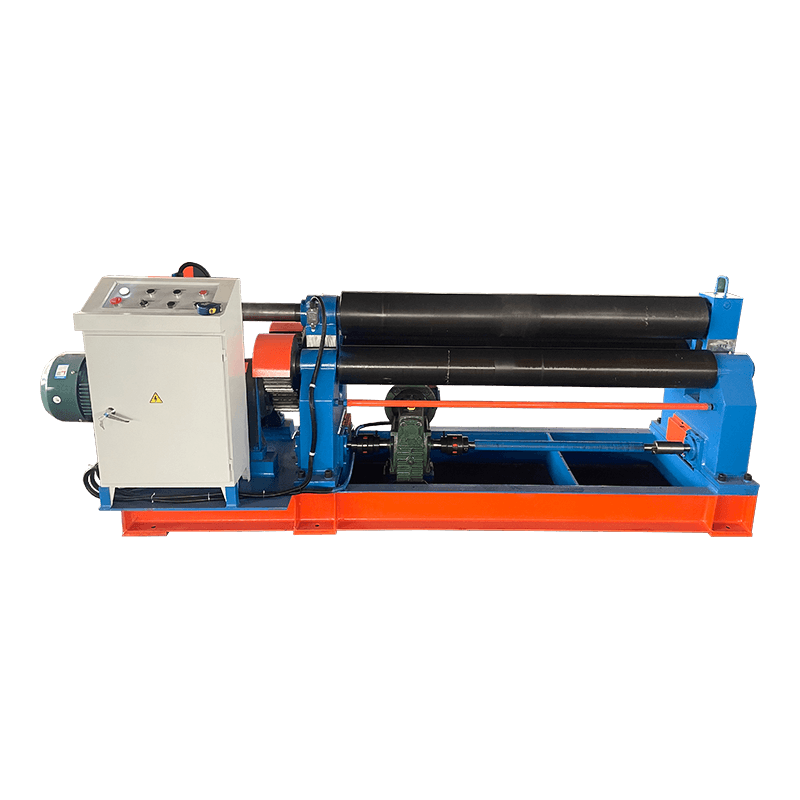
A hydraulic plate rolling machine forms plate by trapping it between a descending upper roll and two driven lower rolls. Hydraulic cylinders push the upper roll down; the lower rolls sit in fixed bearings in the frame and are turned through a hydraulic motor and reducer. Friction draws the plate through the rolls. The vertical offset between the upper roll and the lower rolls sets the curvature, and repeated passes with the upper roll stepped down progressively build a full cylinder.
The hydraulic drive matters for more than convenience. Pressure control gives smooth, repeatable roll positioning, holds the roll against springback in thick plate, and provides an overload cushion that a mechanical screw-down arrangement cannot match. It also makes numerical control practical, which is why most modern machines position the upper roll by programmed radius rather than by hand wheel.
The geometry also explains the machine's biggest limitation. Because the plate must be gripped to be driven, the last stretch of each end cannot reach full curvature on the first pass. That flat end is the "unbent allowance", and it is the single most expensive detail in cylinder rolling: it is either trimmed away, or welded into the seam and dressed flat, or re-rolled in a second setup.
If the longitudinal seam of your shell will sit in a zone that has to be round to within a millimetre, put the budget into a four-roll machine, or into a three-roll universal with genuine end pre-bending. If you roll a wide spread of diameters in small batches and your welders can trim and re-roll the ends, a three-roll symmetric machine will do the job at a far lower capital cost.
| Configuration | End pre-bending | Unbent end allowance | Setup per shell | Best fit |
|---|---|---|---|---|
| Three-roll symmetric (W11) | Not possible in-cycle; ends trimmed or re-rolled | Roughly 1 to 1.5 times the lower-roll centre distance | Longest | Single-diameter runs, light and medium plate, cost-sensitive work |
| Three-roll universal (W11S) | Upper and lower rolls reposition for end pre-bending | Roughly 0.5 to 1 times | Medium | Mixed diameters, cone work, medium plate |
| Four-roll (W12) | Lower rolls rise to pre-bend both ends without unloading the plate | Roughly 0.3 to 0.5 times, close to zero on CNC models | Shortest | Visible-seam shells, stainless and wear plate, repeat batches |
A three-roll universal machine earns its premium through the lower-roll geometry: the two lower rolls can be tilted or clamped so the plate end is bent before the body of the shell is rolled. It is the practical middle ground for a job shop that rolls everything from 3 mm ducting to 12 mm tank shells on the same machine.
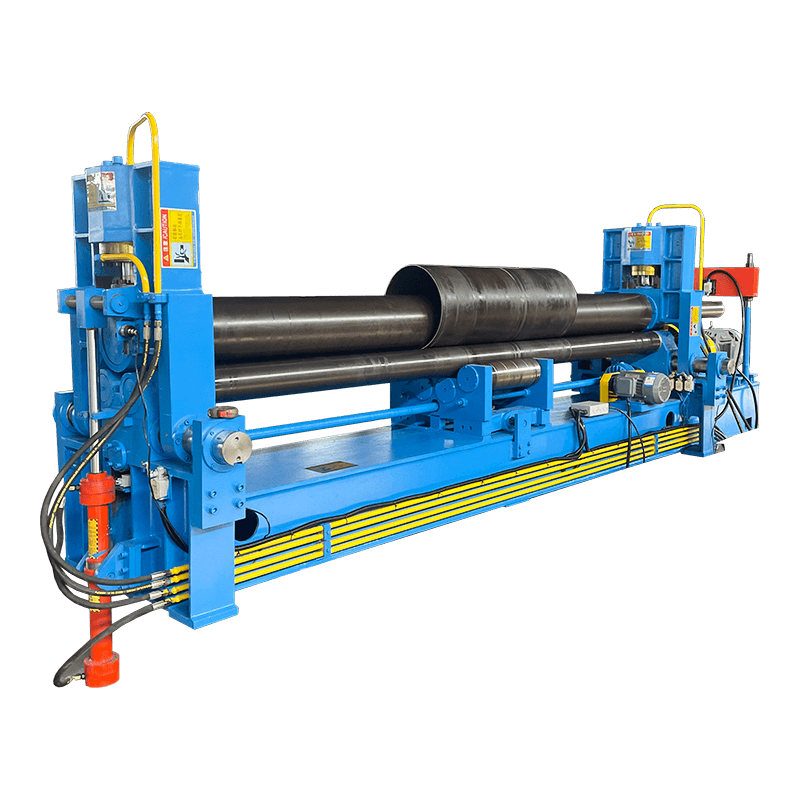 W11S Series Three-Roller Universal Hydraulic Rolling MachineThree-roll universal design supports end pre-bending and continuous rolling, making it a practical middle-ground choice for varied shop work.View Product →
A four-roll machine removes the compromise differently: the lower rolls lift the plate into contact with the upper roll so both ends can be pre-bent without releasing the workpiece. On repetitive work this is not just a quality gain, it is a cycle-time gain, because the operator no longer turns the plate end for end between passes.
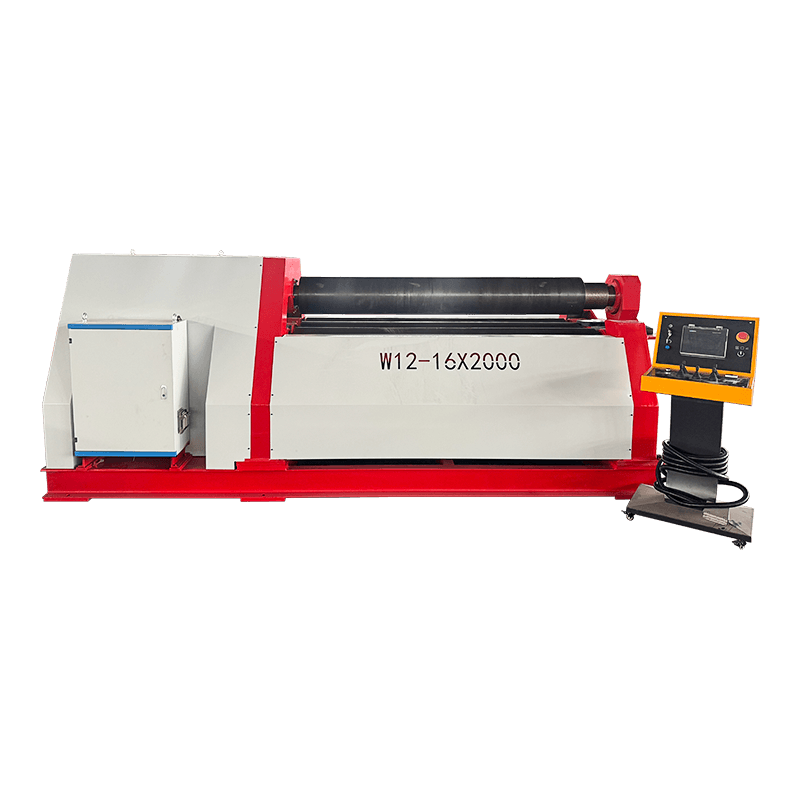 W12 Series Four-Roller Hydraulic Plate Rolling MachineFour-roller hydraulic design pre-bends both plate ends in one setup and supports continuous forming, useful when repetitive rolling needs fewer handling steps.View Product →
Capacity is always quoted against a yield strength. Treat every thickness figure on a quotation as "thickness at X MPa" and ask what X is. Most builders publish rolling capacity against mild steel of roughly 235 to 245 MPa, which corresponds to grades such as S235JR or Q235.
Rolling force scales approximately with the square root of yield strength, so the derating is not linear and it is easy to underestimate. A machine rated 20 mm in mild steel handles about 16 mm of S355 at the same width, and closer to 12 mm of 304 stainless once work hardening is taken into account, because austenitic grades harden as they deform and need extra passes at lower bite depth.
Two further variables quietly move the same number. The first is width: a thickness that is comfortable at 1500 mm may be out of reach at 3000 mm, because the roll diameter needed to resist deflection grows with the cube of the span. The second is the minimum diameter you want to roll — a common rule of thumb puts it at roughly 1.2 times the upper roll diameter for a three-roll machine, which is why thin plate on a small-diameter shell sometimes needs a smaller machine rather than a bigger one.
The headline thickness gets the attention; the following lines decide how many shells leave the shop each shift.
Most rolling problems surface in the first week, not the first year, and almost all of them trace back to a specification that was never tested. Book the acceptance test around the heaviest, widest, most awkward job on your list, not around the demonstrator's favourite shell.
Ask for those measurements in writing. A certificate quoting thickness and width alone tells you nothing about roundness, and roundness is what your welder and your customer will judge the machine on.
Hydraulic rolling machines are mechanically simple, and most failures are fluid-related rather than structural. Oil cleanliness is the first item on any maintenance schedule: contaminated oil scores the pump and makes the upper roll drift under load, which shows up as a taper in the finished shell long before anything visibly fails. Check the return filter, watch for weeping at the cylinder seals, and keep the roll surfaces and the sliding faces of the guideways lubricated to the builder's interval.
Plate condition matters too. Mill scale and grit carried into the nip mark the rolls, and marked rolls print onto every shell afterwards. Wiping plate before it is fed, and cleaning the rolls at the end of a shift, costs minutes and saves a regrind.
When a fault does appear, the useful starting point is the pattern in the finished work: a taper points to roll parallelism, a barrel points to deflection, and slipping points to surface condition or an undersized bite. Further reading on the common failure patterns is collected in this guide to plate rolling problems and solutions, and the full plate rolling machine range covers both three-roll and four-roll configurations for comparison.
These are the questions that come up most often during specification, quotation and first-month operation.
It forms flat plate into cylinders, cones and arcs: tanks, vessels, ducting, pipe, tower sections and hull plating. It replaces hammer-and-former work with a driven, repeatable process.
It depends on width and yield strength, not on one number. A machine rated 20 mm × 2500 mm at 235 MPa rolls roughly 16 mm of S355 or about 12 mm of 304 stainless at the same width.
A three-roll machine needs a separate cycle or handling step to pre-bend the ends, leaving a flat allowance. A four-roll machine lifts its lower rolls to pre-bend both ends in one setup, cutting both the allowance and the cycle time.
Yes, with a capacity reduction. Grades such as 304 and 316 work-harden as they deform, so plan on roughly 50 to 60 percent of the mild-steel rating, more passes at shallower bite, and roll protection against marking.
Price tracks roll diameter, plate width, motor power and control level far more than the headline thickness. A small three-roll machine costs a fraction of a CNC four-roll of the same nominal capacity, so compare quotes only after pinning down capacity at your material grade.
Pre-bending is the first pass, where the plate ends are curved to the final radius before the body of the shell is rolled. Without it the ends stay flat, and that material is either trimmed away or re-rolled in a second setup.
Related Products

Contact us
Factory Address
Xichang industrial Park, Chengdong Town, HaianCity, Nantong City, Jiangsu Province, China
Phone
+86-13906278466
products
QR CODE

 English
 русский
 عربى