Nov 25, 2026
Two fabricators, the same 3-metre plate, two different answers. One runs 2 mm galvanised sheet through a swing beam shear at thirty-plus strokes a minute; the other trims 25 mm wear plate on a guillotine with a 2.5° rake. Both machines are correctly called a hydraulic shearing machine, and both buyers would tell you the other one wasted money.
The short version: below roughly 12 mm in mild steel, a swing beam shear usually covers the work at a lower price and in a smaller footprint. Past 16 mm, or whenever narrow strips and long straight edges decide whether a job makes money, the guillotine is the safer specification. The rest of this page explains where that dividing line actually sits and how to test it against your own plate mix.
Content
Every hydraulic shear follows the same five-step sequence: build pressure, clamp the sheet, drive a blade through it, return, index. The differences that matter sit inside those steps.
The power pack holds oil at roughly 20–30 MPa. A proportional valve meters flow into two or four cylinders mounted in the side frames, and the upper beam travels down a guided path. Before the blade touches metal, a row of hold-down cylinders pins the sheet to the cutting table. Skip that clamp, or run it too light, and the plate lifts, the cut edge curves, and blade edges chip. The moving blade then enters the sheet and the material fractures along the clearance between it and the fixed bed blade. Clearance is set as a share of thickness — commonly quoted around 6–8% for mild steel — while stainless and quenched plate need their own figure from the blade supplier's chart.
The final two steps decide throughput. The return stroke sets cycle time, and the back gauge — usually a ball-screw stop driven by a CNC positioner — sets how quickly the next cut can be queued. If you want the mechanism described stage by stage, this guide to the working principle of a hydraulic guillotine shear walks through it in more detail.
Both designs cut sheet, but the blade travels differently, and that one difference drives everything a buyer cares about — edge quality, thickness ceiling, floor space and price. A guillotine drives the blade down a straight, inclined line, so the cut progresses across the sheet like a pair of scissors closing slowly. A swing beam pivots the blade on a fixed arc, which is simpler, faster on thin sheet and cheaper to build, but the arc tends to bow narrow strips and the edge straightness falls away as thickness climbs.
| Point of comparison | Guillotine (QC11Y/K) | Swing beam (QC12Y/K) |
|---|---|---|
| Blade path | Straight, inclined, rake 0.5–3° | Arc, pivoting on a fixed centre |
| Usual thickness band | 6–25 mm, heavy builds to 40 mm | 0.5–16 mm |
| Edge straightness | High, including narrow strips | Good on thin sheet, drops off on thick plate |
| Distortion on narrow cuts | Low; progressive cut spreads the load | Higher; long strips can bow |
| Footprint and price | Larger C-frame, higher entry cost | Compact, lower entry cost |
| Best fit | Heavy plate, stainless, long straight edges | Light sheet, mixed job shop, high stroke rates |
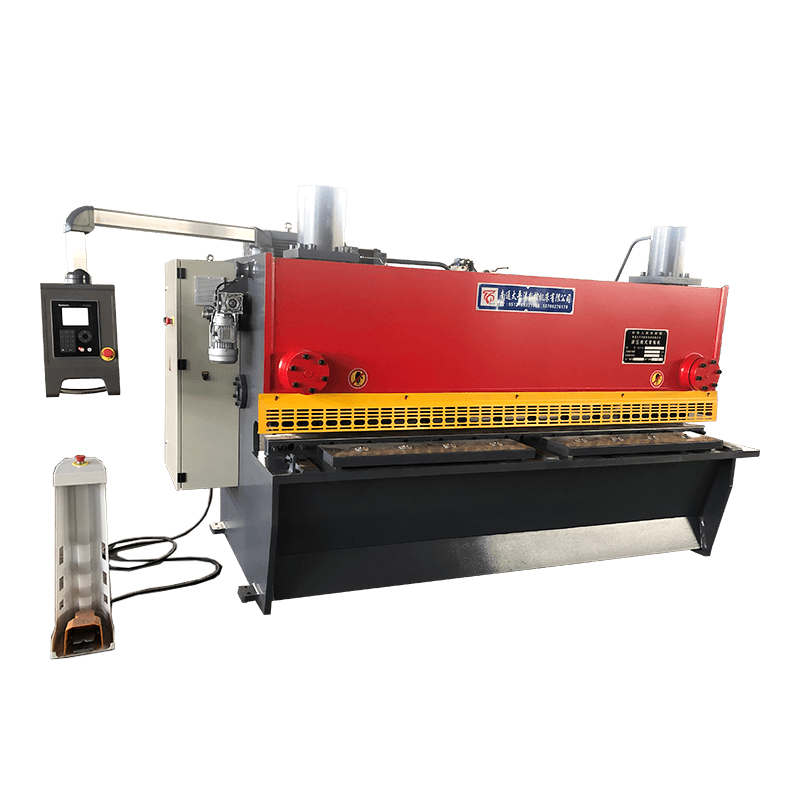 QC11Y/K CNC Hydraulic Guillotine Shearing MachineHigh-precision CNC guillotine shear for carbon steel, stainless steel and aluminum plates, with hydraulic operation and motorized blade-clearance adjustment across the series.View Product →
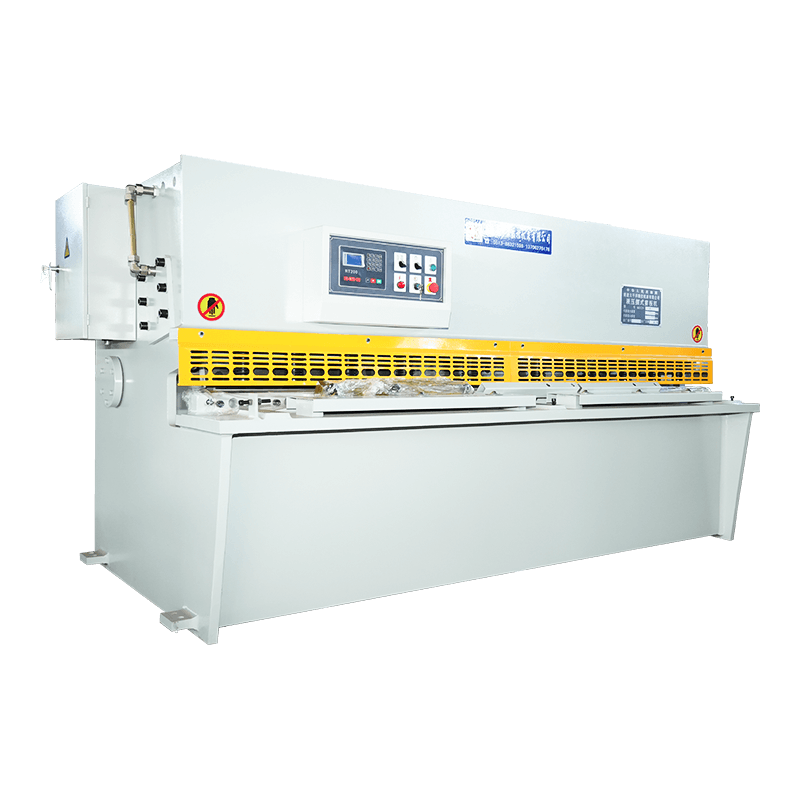 QC12Y/K CNC Hydraulic Swing Beam Shearing MachineHydraulic swing beam shear with ESTUN E21S CNC control, precise rear stop and 6CrW2Si blades, suited to sheet metal fabrication and thinner-plate cutting.View Product →
Most quotation errors start here. Cutting force scales with plate thickness, cut length and the shear strength of the material — it does not scale with the tonnage badge on the side frame. A machine rated for 6 mm mild steel across 3050 mm will not cut 6 mm stainless at the same length, because stainless carries a noticeably higher shear strength than mild steel. Ask for the capacity chart in the grades you run, not in mild steel alone.
Three specifications decide whether the machine fits the shop rather than the catalogue: cut length, throat depth and back gauge travel. Cut length must exceed your longest blank, because trimming a 3050 mm sheet on a 2500 mm machine simply cannot be done in one pass. Throat depth limits how wide a blank can pass the frames. Back gauge travel sets how far the stop can retract, which matters as soon as you cut repeat strips from a long sheet rather than full-size blanks.
Rake angle deserves its own line in the specification. A shallow rake of 0.5–1.5° suits thin sheet and keeps distortion low; thick plate needs 2–3° to concentrate force, but the steeper the rake the harder the blade pushes the strip sideways, which is exactly why narrow cuts on a swing beam tend to bow. The full shearing machine range separates guillotine and swing beam builds so the two can be compared on the same job rather than on price alone.
Two machines can share an identical specification sheet and still feel entirely different on the floor. These are the details worth inspecting before money changes hands:
Bring these six answers to any supplier conversation and the shortlist narrows quickly:
Related Products

Contact us
Factory Address
Xichang industrial Park, Chengdong Town, HaianCity, Nantong City, Jiangsu Province, China
Phone
+86-13906278466
products
QR CODE

 English
 русский
 عربى